

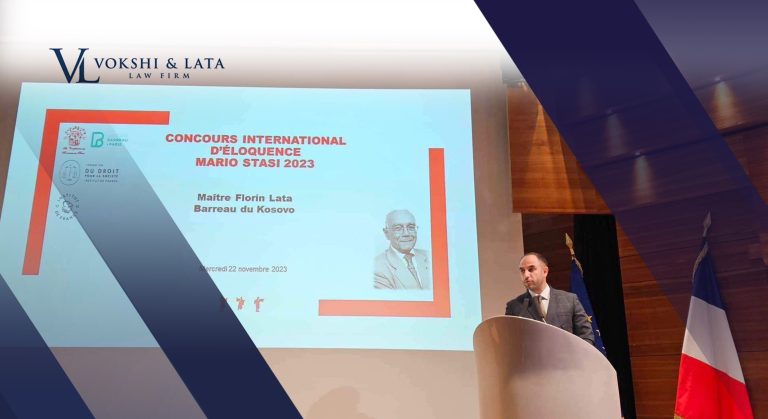
Author: Florin Lata
Some symbols emerge from the tragedies endured by their people and inspire generations to defend freedom. Some men inspire an entire nation. Some legal professionals leave a legacy that shapes and becomes part of the democratic foundations of a nation.
I would like to share with you the extraordinary story of Bajram Kelmendi, a man who dedicated his life to defending the rights and freedoms of others, despite the personal hardships and sacrifices he endured.
Bajram Kelmendi was born into a troubled world, where freedom and justice were often disregarded. He encountered injustice during his childhood when, at the age of eight, he and his family were imprisoned for political reasons by the Yugoslav regime. Despite these difficult circumstances, he never lost his faith in justice or in the ability of individuals to bring about change.
While still in secondary school, at the age of 20, Bajram was arrested for his political activities and sent to prison. It was there that he discovered his calling and decided to dedicate his life to defending human rights.
As the philosopher Albert Camus once wrote, “In the midst of winter, I found there was, within me, an invincible summer.” This is precisely what happened in Bajram’s life.
The injustices experienced by the people of Kosovo, together with his repeated imprisonment, undoubtedly formed the foundation of his determination to defend human rights and become a criminal defence lawyer.
He took on the most challenging cases, representing political defendants and joining forces with other lawyers to investigate crimes committed by Yugoslavia against the Albanian population.
His clients described him as a king in the courtroom, a determined and dedicated lawyer who fought tirelessly to secure justice on their behalf. They also regarded him as a source of hope because he firmly believed in the causes he defended and never surrendered.
Throughout his career, he represented politicians, journalists, students, professors, miners, and many others.
Bajram Kelmendi was also a man of culture and knowledge. He knew by heart verses from Omar Khayyam’s Rubaiyat and Gjergj Fishta’s The Highland Lute (Lahuta e Malësisë). His passion for literature, poetry, and music reflected the depth of his character.
However, Bajram Kelmendi’s work extended far beyond defending clients in courtrooms, as he undertook responsibilities that went well beyond the traditional role of a lawyer.
He regularly prepared reports documenting torture in prisons, recording human rights violations and demanding justice. He submitted these reports to international institutions and organisations, including the OSCE, the Council of Europe, and Amnesty International.
His commitment to justice knew no boundaries.
As Bajram Kelmendi himself stated, “Where violence is used, the truth cannot be found.”
He became the voice of the oppressed, a defender of their rights and a messenger of truth, believing in the power of international justice.
Thus, on 3 May 1998, he submitted a second criminal complaint against Slobodan Milošević and other Yugoslav leaders before the International Criminal Tribunal for the former Yugoslavia.
This action provoked strong opposition from the leadership in Belgrade, which, as described in the account of his life, ultimately led to the decision to take his life on 25 March 1999, together with the lives of his two sons.
It is important to emphasise that Bajram Kelmendi was the victim of a criminal execution carried out by Serbian forces, depriving him of his fundamental right to a fair trial.
Today, Bajram Kelmendi’s legacy lives on.
His daughter, also a lawyer, practises law in a free and democratic Kosovo, proudly following in her father’s footsteps.
Bajram Kelmendi remains a role model for young lawyers in Kosovo and throughout the world. His determination to defend human rights has left an indelible mark and will continue to guide future generations.
A street in the centre of Prishtina bears his name in recognition of his lifelong commitment to Kosovo’s freedom.
It is important to emphasise that those responsible for his murder have never been brought to justice, despite repeated calls for accountability.
The struggle for truth and justice continues, and we, as lawyers around the world, must stand united to ensure that the tragedy of Bajram Kelmendi is never repeated.
The legal profession is much more than a profession; it is a mission.
The role of lawyers in defending human rights becomes even more important under dictatorial regimes, where justice and truth are often suppressed.
Lawyers become guardians of human rights and voices of justice and truth. Those in power may regard them as enemies, and lawyers may face serious mistreatment and persecution. However, this must not discourage us.
As the Scottish historian Thomas Carlyle aptly observed, “Where injustice reigns, the state becomes a battlefield and every citizen a soldier.”
We, lawyers throughout the world, must stand together in support of our colleagues who practise under difficult circumstances.
We must work to ensure that the memory of Bajram Kelmendi is never forgotten and that his legacy continues to inspire the pursuit of justice and freedom.
As lawyers, we have a responsibility to defend the rights and freedoms of every individual, wherever we may be.
This article was first presented at the Paris Bar Association in France.
